Species: Dogs & Cats16 dose protocols9 dosage forms
This page is a calculation and educational reference for veterinarians and veterinary students. It does not replace examination, culture and susceptibility testing, clinical judgment, or the attending veterinarian's final decision.
General dose: 5 mg/kg PO · every 12 h (or 10 mg/kg once daily)Source: Plumb's (general)
Spectrum of activity
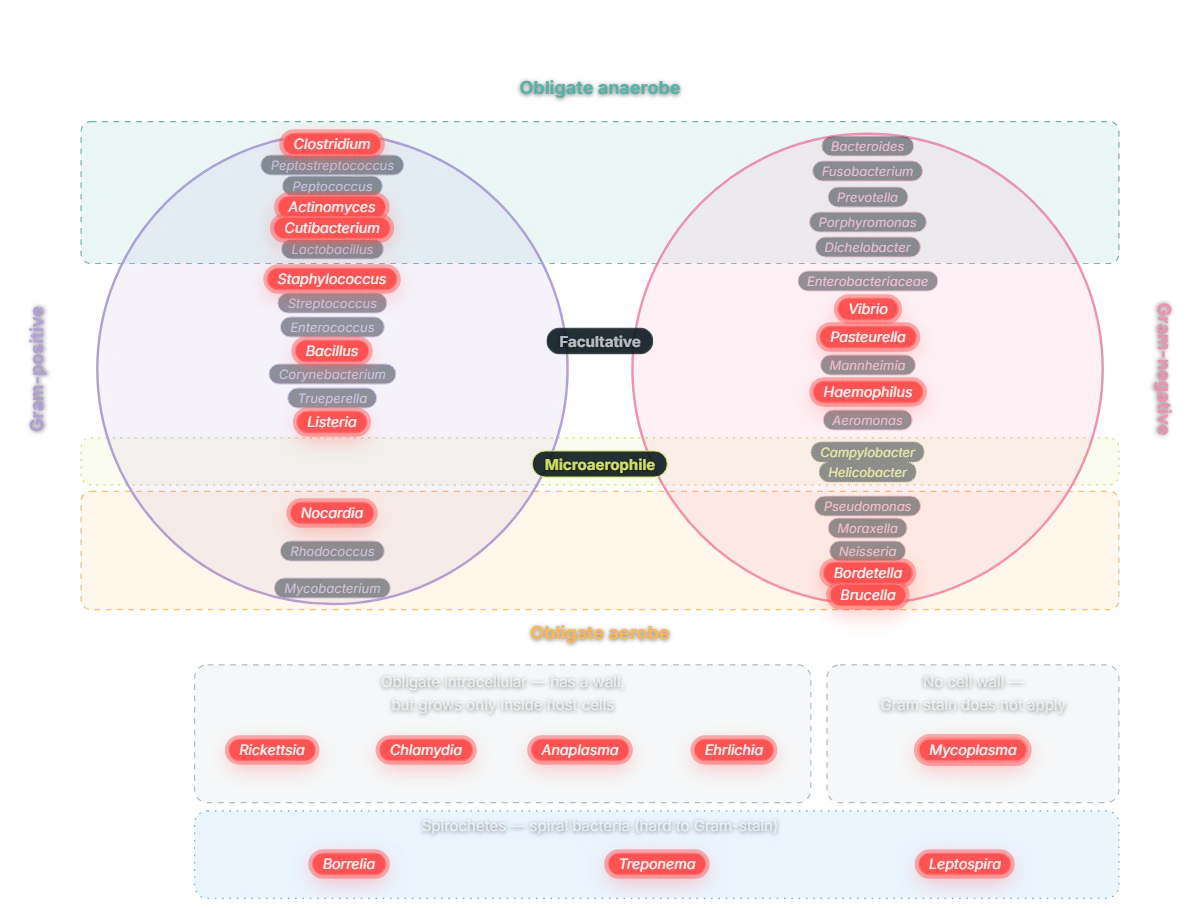
A broad-spectrum, bacteriostatic tetracycline; its strength is intracellular/atypical bacteria and spirochetes — Rickettsia, Ehrlichia, Anaplasma, Mycoplasma, Chlamydia and spirochetes (Borrelia of Lyme disease, Leptospira, Treponema). It also covers part of the Gram-positives (Actinomyces, Listeria, Cutibacterium) and Gram-negatives (Pasteurella, Bordetella, Brucella, Haemophilus, Vibrio). Activity against Staphylococcus, and especially Nocardia, is species-, isolate- and susceptibility-dependent and must not be assumed without AST; doxycycline is also unreliable against streptococci. Resistance is common among Enterobacteriaceae (E. coli, Klebsiella), Bacteroides and Pseudomonas.
Open the full-size spectrum image
Veterinary uses and doses
General (susceptible) infections
DogSource: Greene 2006
General infection: 3–5 mg/kg · every 12 h · 7–14 days
DogSource: Greene 2006
Soft tissue / UTI: 4.4–11 mg/kg · every 12 h · 7–14 days
CatSource: Vaden 1995
General infection (cat): 5 mg/kg PO (or IV) · every 12 h
CatSource: Greene 2006
Systemic infection / bacteremia (cat): 5–11 mg/kg PO or IV · every 12 h
Ehrlichiosis / Anaplasmosis
DogSource: ACVIM / Merck
Canine ehrlichiosis/anaplasmosis (E. canis): 5 mg/kg every 12 h or 10 mg/kg every 24 h · 28 days
Clinical note: The standard course for canine monocytic ehrlichiosis (E. canis) is 28 days; shorter courses may transiently improve signs but relapse is common. Clinical improvement is usually seen within 24–48 hours.
DogSource: ACVIM / Greene
Severe/chronic cases (E. canis): 10 mg/kg · every 24 h · 28 days
Clinical note: Even in the chronic/severe (pancytopenic) phase the standard doxycycline course is still 28 days, and prolonging the antibiotic alone is not recommended. Hematologic abnormalities may take 3–6 months to normalize (this is not treatment failure). The prognosis of this phase is guarded and often needs supportive care (transfusion, and immunosuppression for the immune-mediated component); selected refractory cases are extended to about 6 weeks per clinical judgment.
CatSource: Greene 2006
Feline ehrlichiosis/anaplasmosis: 5–10 mg/kg · every 12 h · 21–28 days
Lyme disease
DogSource: ACVIM Lyme consensus (2018)
Lyme disease: 10 mg/kg · every 24 h · 30 days
Clinical note: Doxycycline is first-line for Lyme disease. The commonly used lower-dose regimen is 10 mg/kg every 24 hours (or the same total daily dose divided as 5 mg/kg every 12 hours) for 30 days.
Rocky Mountain spotted fever (Rickettsia)
DogSource: Breitschwerdt 2000
RMSF (Rickettsia rickettsii): 5 mg/kg · every 12 h
Leptospira renal carrier: 5 mg/kg · every 12 h · 14 days (alternative: 10 mg/kg every 24 h)
Clinical note: Doxycycline is the drug of choice for leptospirosis and eliminates renal carriage. The standard regimen is 5 mg/kg PO every 12 hours (or the equivalent 10 mg/kg every 24 hours) for a total 14-day antimicrobial course; avoid 10 mg/kg every 12 hours. If vomiting or another adverse effect initially prevents doxycycline, aqueous penicillin G 25,000–40,000 U/kg IV every 6–8 hours may be used only as initial therapy. Start doxycycline as soon as it is tolerated and continue it to complete the 14-day total course.
Hemoplasmosis / hemotropic mycoplasmosis
CatSource: ABCD feline haemoplasmosis guideline
Feline hemoplasmosis (M. haemofelis): 10 mg/kg · every 24 h (or 5 mg/kg every 12 h) · 28 days
Clinical note: The recommended course is usually 2–4 weeks; treatment does not necessarily eradicate the infection and the cat may remain a carrier.
Clinical feline bartonellosis: 10–15 mg/kg PO · every 12 h · as part of an individualized combination regimen · about 6 weeks
Combination therapy: with a suitable fluoroquinolone such as pradofloxacin 5–7.5 mg/kg PO every 12 h; introduce regimen components at least 5 days apart to reduce the risk of a shock-like reaction, and individualize the final combination to the clinical presentation with specialist input
Clinical note: Consider this regimen only for the rare patient with clinically attributable Bartonella disease after exclusion of other diagnoses and appropriate laboratory support. A positive serology or PCR result alone is not an indication for treatment, and healthy carriers are not treated routinely. Controlled efficacy data in cats are lacking; a course of about 6 weeks must be individualized.
Toxoplasmosis
DogSource: Lappin 2000
Toxoplasma (dog): 5–10 mg/kg · every 12 h · 4 weeks
CatSource: Lappin 2000
Toxoplasma (cat): 5–10 mg/kg · every 12 h · 4 weeks
Salmon poisoning (Neorickettsia)
DogSource: Rikihisa 2005
Salmon poisoning: 10 mg/kg IV · every 12 h · at least 7 days
Anti-inflammatory (joint) effect
DogSource: Greene 2006
Anti-inflammatory joint effect: 3–4 mg/kg · once daily · 7–10 days
Dosage forms
Capsule 100 mg
Capsule 50 mg
Capsule 20 mg
Tablet 100 mg
Tablet 50 mg
Tablet 20 mg
Suspension 25 mg/5 mL
Syrup 50 mg/5 mL
Injectable (diluted solution 10 mg/mL)
Safety and clinical notes
⚠️ In cats, never give a tablet or capsule “dry” — the risk of esophageal stricture is serious; follow with at least 6 mL of water or food, or use a liquid/paste form.
For a fractional capsule dose, open and mix only an immediate-release product as directed by the prescribing veterinarian; prepare each dose fresh, mix thoroughly, and do not store a home-prepared mixture without validated stability data.
Use with caution in young and pregnant animals (possible tooth discoloration and effects on bone — although less than with other tetracyclines).
Unlike other tetracyclines it can be used in renal impairment (mainly fecal excretion); but in severe hepatic disease (especially in cats) reduce the dose or avoid it.
Oral absorption is reduced by calcium, magnesium, iron, zinc and aluminium cations, as well as antacids and dairy products; separate the timing of administration.
Photosensitivity may occur.
Oral or IV only; IM or SC injection is not recommended, and IV must be slow and diluted.
The most common adverse effects are GI: nausea, vomiting, diarrhea and anorexia.
There is no approved systemic veterinary product; use in dogs and cats is extra-label.