Species: Dogs & Cats7 dose protocols4 dosage forms
This page is a calculation and educational reference for veterinarians and veterinary students. It does not replace examination, culture and susceptibility testing, clinical judgment, or the attending veterinarian's final decision.
Dose reference only—not an empiric regimen: 25 mg/kg parenteral · every 12–24 hSource: Plumb's (general)
Spectrum of activity
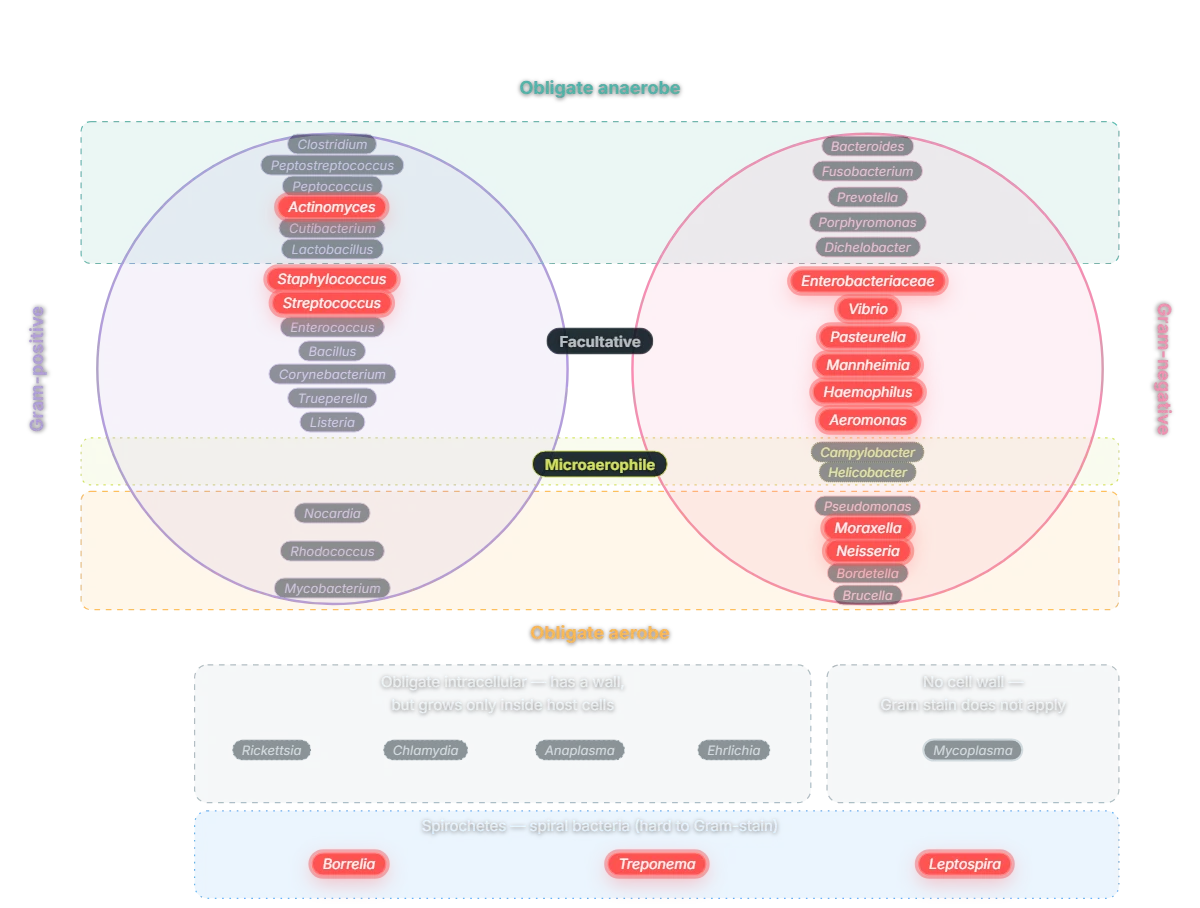
A third-generation, bactericidal cephalosporin with broad Gram-negative coverage (Enterobacteriaceae such as E. coli and Klebsiella, Pasteurella, Haemophilus, Neisseria) and good penetration into the central nervous system. It is active against streptococci and methicillin-susceptible staph, and also covers spirochetes (Borrelia of Lyme disease, Leptospira). But it has no activity against Pseudomonas, Enterococcus and Listeria (intrinsic cephalosporin resistance), methicillin-resistant staph (MRSA), or intracellular/cell-wall-free bacteria (Mycoplasma, Rickettsia). Its anaerobic coverage is weak; for anaerobic infections it is usually combined with metronidazole.
Open the full-size spectrum image
Veterinary uses and doses
General / systemic infection
DogSource: Rebuello/Albarellos 2002
50 mg/kg IM · once to twice daily
DogSource: Trepanier 1999
15–50 mg/kg parenteral · once daily
CatSource: Greene 1998
Cat: 25–50 mg/kg IV, IM or IO · every 12 h
Meningitis / borreliosis (Lyme)
DogSource: Greene 1998
15–50 mg/kg IV or IM · every 12 h · 4–14 days
Clinical note: The usual single-dose maximum (based on human data) is about 1 gram.
Skin & genitourinary
DogSource: Greene 1998
25 mg/kg IM · once daily · 7–14 days
Infective endocarditis
DogSource: DeFrancesco 2000
20 mg/kg IV · every 12 h
Clinical note: In endocarditis, used as an alternative when fluoroquinolones and aminoglycosides are resisted or contraindicated.
Surgical prophylaxis
DogSource: Greene 1998
25 mg/kg IV or IM · single dose (pre/intra-op)
Dosage forms
Vial 1000 mg (1 g)
Vial 500 mg
Vial 250 mg
Vial 2000 mg (2 g)
Safety and clinical notes
⚠️ Reserve-drug quick reference: the general dose is a calculation reference, not an empiric treatment regimen. Use ceftriaxone only for a defined indication and, whenever feasible, a susceptible isolate documented by culture and susceptibility testing when narrower first-line options are unsuitable.
Injectable only (not absorbed orally): IV or IM. Give IV as an infusion over at least 30 minutes in compatible fluids (normal saline, D5W, or dextrose-saline); IM injection is painful.
⚠️ Do not reconstitute or further dilute ceftriaxone with calcium-containing fluids (such as Ringer's, lactated Ringer's, or Hartmann's), and do not mix or administer them simultaneously through the same IV line. If sequential administration is required in a non-neonatal patient, thoroughly flush the line with a compatible fluid between infusions; avoid ceftriaxone in neonates receiving IV calcium.
Contraindicated in cephalosporin allergy; up to 16% of penicillin-allergic patients may cross-react.
Dose adjustment is needed in severe renal impairment or concurrent hepatic dysfunction; avoid in jaundice (icterus).
Adverse effects: hematologic reactions (eosinophilia, thrombocytosis or thrombocytopenia, leukopenia, neutropenia), diarrhea, mild azotemia, and IM injection-site pain.
Reconstitute the vial powder with sterile water, normal saline or D5W (choose the diluent volume in this app); at about 100 mg/mL it is stable refrigerated for up to 10 days. Common vials: 250, 500, 1000 and 2000 mg.