Species: Dogs & Cats9 dose protocols6 dosage forms
This page is a calculation and educational reference for veterinarians and veterinary students. It does not replace examination, culture and susceptibility testing, clinical judgment, or the attending veterinarian's final decision.
General dose: 5–10 mg/kg PO · once dailySource: Plumb's (general)
Spectrum of activity
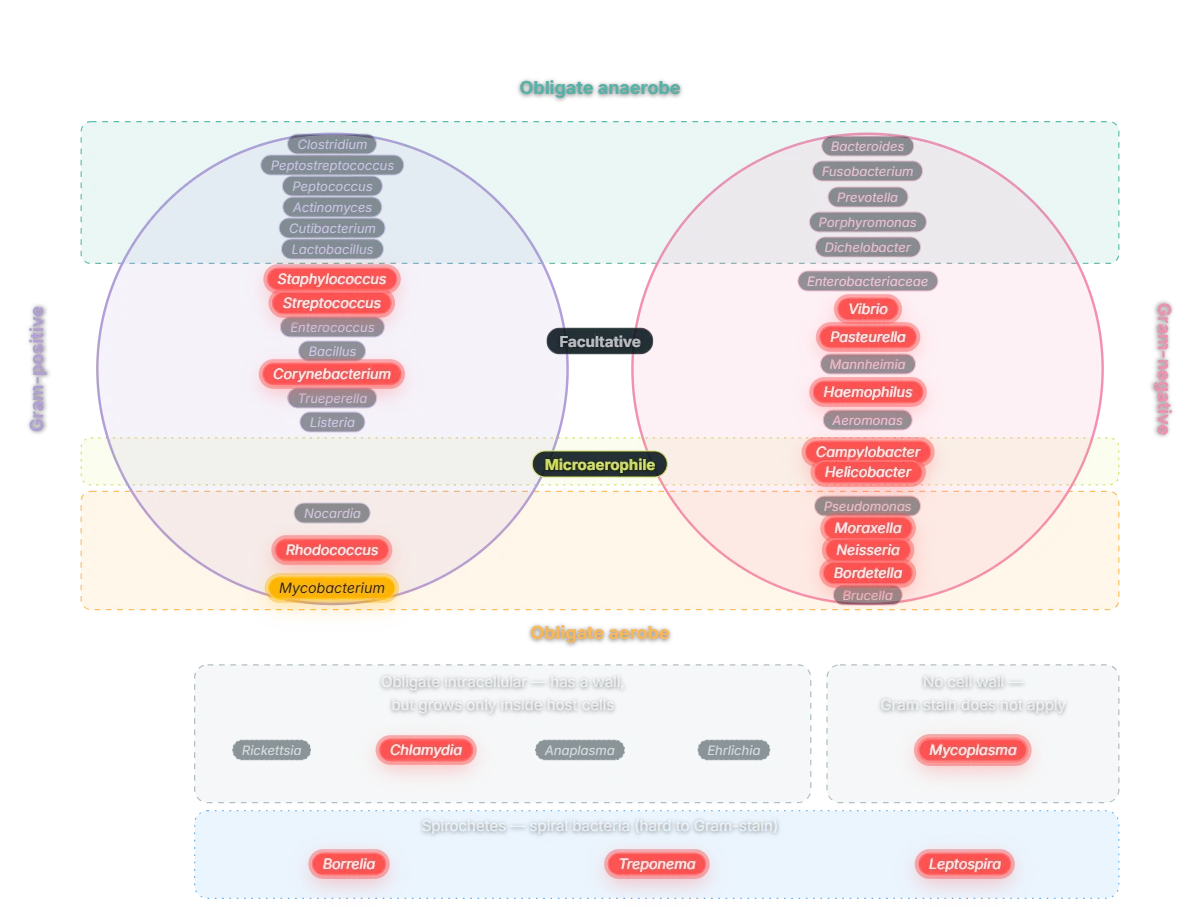
A macrolide (azalide), bacteriostatic, with very high tissue penetration and a long half-life; its strength is intracellular/atypical and respiratory bacteria — Chlamydia, susceptible respiratory Mycoplasma species, Bordetella and Haemophilus — as well as Campylobacter, Helicobacter, streptococci and susceptible staph. Mycoplasma coverage is species-dependent and must not be generalized to all species. Activity against spirochetes (Borrelia) and intracellular Rhodococcus is organism-dependent. For selected nontuberculous mycobacteria, including some Mycobacterium avium complex isolates, azithromycin is only an organism-specific component of multidrug therapy after speciation and susceptibility assessment—not reliable monotherapy. But it is not reliable against Enterobacteriaceae (E. coli), Pseudomonas, enterococci and anaerobes. ⚠️ It is ineffective against Mycoplasma haemofelis (feline hemotropic mycoplasma).
Open the full-size spectrum image
Veterinary uses and doses
General (susceptible) infection
DogSource: Sykes 2003
5–10 mg/kg · once daily · 3–5 days
CatSource: Sykes 2003
Cat: 5–10 mg/kg · once daily · 3–5 days
Skin (pyoderma / dermatology)
DogSource: Merchant 2000
Dermatology: 5–10 mg/kg · once daily · 3–5 days
DogSource: Ramadinha 2002
Pyoderma: 10 mg/kg · once daily · 5–10 days
CatSource: Merck Veterinary Manual (2025)
Cat (dermatology): 7–15 mg/kg · every 24 h · 5–7 days
Upper respiratory infection (URI)
CatSource: ISCAID respiratory guideline 2017
Cat URI — reserve option: 5–10 mg/kg PO every 12 h on day 1, then every 72 h
Clinical note: Reserve azithromycin for cases in which doxycycline and amoxicillin are unsuitable and feline chlamydiosis is unlikely. Doxycycline remains first-line for suspected Chlamydia felis. Reassess clinical response after 7 days. For chronic disease, if continued after reassessment, treat for at least 7 days beyond clinical resolution or a stable clinical plateau; do not apply a routine fixed 6–8-week course.
Babesiosis (B. gibsoni)
DogSource: Birkenheuer 2004
10 mg/kg · once daily · 10 days
Combination therapy: with atovaquone 13.3 mg/kg every 8 h with a fatty meal; both drugs for 10 days
Pulse (extended-interval) dosing
DogSource: Aucoin 2002
5 mg/kg · days 1 and 2 daily, then one dose every 3–5 days (5 doses total)
CatSource: Aucoin 2002
Cat: 5 mg/kg · days 1 and 2 daily, then one dose every 3–5 days (5 doses total)
Dosage forms
Suspension 200 mg/5 mL
Suspension 100 mg/5 mL
Capsule 250 mg
Capsule 500 mg
Tablet 250 mg
Tablet 500 mg
Safety and clinical notes
Use with caution in hepatic impairment (metabolism and excretion are mainly hepatic-biliary).
The most common adverse effects are GI (vomiting, especially with high doses, and diarrhea); but less than with erythromycin.
Absorption is reduced by magnesium- or aluminium-containing antacids; separate by about 2 hours.
It may raise cyclosporine and digoxin levels; use with caution alongside them.
Follow the specific product label after reconstitution. For Zithromax oral suspension, store at 5–30°C (do not refrigerate), shake well, and use within 10 days.
It has a very long tissue half-life; this is what makes once-daily and pulse (extended-interval) regimens possible.
⚠️ It is ineffective against Mycoplasma haemofelis (feline hemotropic mycoplasma); use doxycycline for that.